Uniswap Community Proposal Factory

Summary & Motivation
GFX Labs and its team have participated in protocol governance for over four years. In fact, Getty’s first governance proposal was a Compound Crowd Proposal, also known as a Compound Autonomous Proposal (CAP), in September 2020. At the time, to make a Compound Proposal a contributor needed 100k COMP (~$14m) votes. While that was unattainable for most contributors, CAPs allowed anyone with 100 COMP ($14k) to make an Autonomous Proposal.

At its core, a CAP allowed smaller users a path to make a proposal through the primary governance contract by first proposing it to the CAP. Once the CAP was created, the creator needed to lobby community members to delegate their voting power to the CAP, and once that voting weight reached 100k, it was eligible to become a proposal for the DAO.

In concept, CAPs were a great solution to get small, intelligent, and valuable participants engaged in protocol governance. Most delegates, however, could not delegate their COMP tokens to a CAP. Unfortunately, because delegations cannot be re-delegated except by the token holder, CAPs only democratized proposal power at the margins. We’ve also seen this at Uniswap for those who remember fish.vote.

To solve this problem, we are introducing the Community Proposal Factory (CPF), the modern version of a CAP, which can propose, and then support by voting upon, a proposal by first clearing a lower-level vote.

Overview
The CPF is effectively a subDAO of a larger protocol with a significantly lower proposal threshold.

Anyone who meets the proposal threshold can create a Community Proposal. This can be thought of as a proposal seeking to attract and pool the voting power of multiple UNI holders and delegates to meet the proposal threshold.

If the Community Proposal receives a sufficient number of votes to initiate a standard proposal, the CPF pushes the proposal to the primary governance contract as a standard proposal, and at that point, governance proceeds as it does today. This structure removes the need for new delegations to be made for each CAP, and instead, governance token holders may leave their delegation on the CPF.

Community Proposal Factories effectively lower the proposal threshold without an increase in security risks to the DAO. In doing so, we feel Community Proposals will represent a big step in democratizing proposal power.

Once deployed, anyone can craft a proposal with executable code without needing a large amount of capital (or commanding the delegated votes of a large amount of capital), and the broader governance tokenholder community can judge whether the proposal should advance to a full vote. It also filters spam proposals before hitting the main voting venue, since it is optional for UNI holders and delegates to vote on a Community Proposal.

The Community Proposal Factory is compatible with Governor Bravo-based DAOs and can be easily deployed by anyone. Each deployer can configure the factory to their DAO, requiring only minor configurations. In addition, this concept could be applied to other common governance frameworks such as OpenZeppelin’s Governor. Deployed CPFs can spin up an interface easily using Tally.
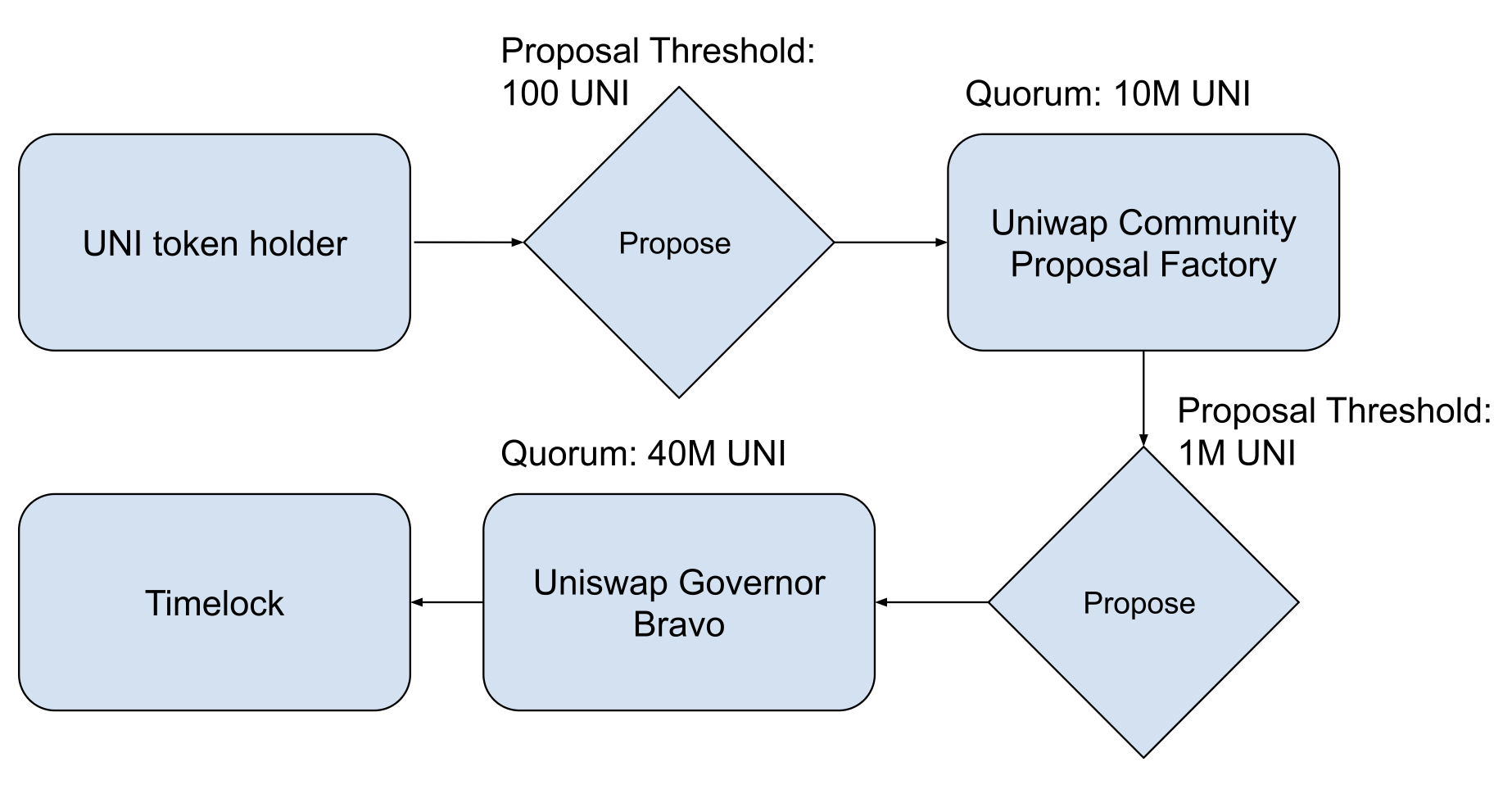
The above diagram is an example of how a Community Proposal Factory could be applied to Uniswap. In this example, the factory is deployed with the Uniswap Governor Bravo contract as the parent DAO contract, the UNI token as the governance token for the factory, a proposal threshold of 100 UNI votes, and a quorum of 10M UNI.

Anyone with 100 UNI can create a Community Proposal within the CPF. Similar to a regular vote, if the proposal reaches the necessary quorum (10M UNI), then the proposal is deemed successful.

If the proposal is successful and if the Uniswap CPF has the required voting power delegated to it, the execute function will create the proposal on the Uniswap Governor Bravo contract, and then vote in favor of it when the voting begins.

At this point, the governance process is identical to any other vote. The proposal will go through the standard review, voting – and, if successful – timelock before execution.

Because the CPF is self-contained and cannot pass a standard proposal more easily than a human delegate, funds & protocol functions are not believed to be at increased risk. As a result, we do not believe the expense of an audit is required, but we can add additional funding to the proposal to cover one if delegates are strongly in favor.

Initial parameters (review period, voting period, timelock) within the CPF will be within standard governance practices, and can be fine-tuned for the final Tally vote if delegates have strong opinions. Multiple proposals are queued for submission to Governor Bravo in order of their passage at the CPF level. Should a backlog of proposals by the CPF to Governor Bravo be expected, multiple CPFs could be deployed, requiring additional treasury delegation.

Deployment:

  1. Configure CPF and deploy. Anyone can do this, and you only need to do it once. Parameters such as the proposal threshold and quorum can be changed by the CPF’s voters.

  2. Delegate 20M UNI from the DAO treasury to the CPF to ensure not only the ability to propose, but also end quorum failures due to low active voting supply.

Proposal Process:

  1. Anyone with 100 UNI votes can post a Community Proposal to the CPF.

  2. UNI voters can vote on CPF proposals if they wish. If the For votes cast meet or exceed the 10M UNI quorum and outnumber the Against votes, then the proposal can be proposed by the CPF to the Uniswap governance contract. At this point, the CPF must have the sufficient votes delegated to it to make the proposal on the parent contract and must maintain the voting power for the duration of the standard proposal.

  3. After the standard proposal is made, it is up to the DAO’s standard process to determine if the proposal is executed.

Specification

  1. GFX Labs or another contributor will deploy a Community Proposal Factory for Uniswap.

  2. Uniswap governance delegates 20M UNI from the DAO treasury to the CPF via the franchiser.

  3. Uniswap governance provides $75,000 in UNI to gfxlabs.eth to cover the expense of development and testing.

The Community Proposal Factory will safeguard the ability to continue protocol governance while maintaining the security and integrity of the DAO. By streamlining the process for smaller token holders to introduce executable proposals and aggregate support, the CPF empowers a broader range of contributors without requiring prohibitive amounts of capital or delegation.

Ultimately, the CPF strengthens community engagement, filters low-quality proposals, and provides lubricant to the gears of Uniswap governance, helping to mitigate the ongoing attrition amongst active voting supply.

7 Likes

While we appreciate the proposal, we believe at the moment it’s not a big issue regarding launching proposals. There are many delegates with enough voting power that helps with those who are interested in launching proposals. In addition, at least delegates checking these proposals before helping to launch help to filter potential malicious proposals. We don’t believe it’s good idea to allow easier spamming of DAO governance. In addition, while we agree that quorum is a serious issue, 20 mil uni delegation is a large amount and should be considered carefully

1 Like

We would beg to differ. Over the last year, the Uniswap DAO has only passed 16 proposals. Many of which have been authored by a recurring small population of delegates. The Uniswap DAO has a fundamental issue. The barrier to proposing an idea and having it reach a governance decision is an extremely high threshold, which has had a long-term effect of discouraging proposals, leading to the stagnation of ideas and, consequently, the progress that UNI token holders are witnessing.

While this proposal will not resolve the issue of voter engagement, it can effectively enhance ideation and the exchange of new ideas within the DAO. That alone could bring about higher voter engagement.

This is a low-risk, high-reward initiative.

3 Likes

If you can let the community know many non malicious projects or ideas that were unable to find sponsored delegates to launch proposals, your point would be more valid. At the moment, this seems to be a non issue however.

1 Like

We appreciate the effort that went into this proposal and see the value in lowering barriers for smaller token holders to participate more directly in governance.

That said, we believe the timing may not be right. The DAO is currently facing a more pressing challenge with quorum, and resolving that should take priority before introducing new governance layers.

While it is true that smaller delegates cannot technically open proposals on their own, in practice, the DAO has developed an effective workaround: larger delegates often sponsor proposals from smaller ones. This dynamic has enabled important initiatives to move forward. For example, as kpk we were able to successfully introduce and pass the Onboarding Package for Gnosis Chain proposal with the sponsorship of PGov.

For these reasons, while we see merit in the Community Proposal Factory, we encourage addressing quorum and governance participation at the broader level before introducing additional mechanisms.

1 Like

Hi @GFXlabs!

At first glance, our view is similar to that @Doo_StableLab: this proposal could generate unnecessary spam by setting such a low threshold of 100 UNI (currently worth less than $800). We also wonder whether this system might introduce more bureaucracy and complexity, given that any proposal submitted through this mechanism would require two votes: one via the CPF module and one in the regular governance vote.

That being said, we would like to ask you a few questions to gain a better understanding of the proposal:

  • Does adding and deploying the CPF module to the current governance contracts require any modification to the existing governance contract? We are concerned about the potential risks this could bring.
  • Why delegate 20M UNI to the CPF when the proposed quorum is 10M?
  • Why did you set the amount at 100 UNI (currently around $750) for anyone to activate the mechanism and make a CPF proposal? Don’t you think that’s too low a threshold to activate the governance system, which could lead to a lot of spam proposals?
2 Likes

Good question. Since a CPF proposal only advances to the Uniswap DAO once it has passed the 10M quorum, the core DAO should be protected from spam. In the the event the CPF sees many low quality proposals a CPF proposal can raise the proposal threshold.

The CPF system is at least equivalent to the current three-step system: RFQ, Temperature Check, and then Onchain vote. The CPF would simply replace the Temperature Check because it has the same 10M quorum requirement and 5-day voting period.

We would say the CPF reduces the bureaucracy because it’s a better-defined and more accessible system than the current legacy system.

Great question, the CPF module does not modify the existing governance contract. It’s fully independent.

This was to address the concern @kpk raised that the DAO is currently facing an issue reaching quorum. Rather than using direct treasury delegation, this approach can help the DAO reach quorum while maintaining control over voting power and reducing the risk of delegate concentration.

We wanted to start with a very accessible system. For many people $750 is a non-trivial sum. The only risk is that the CPF gets spam proposals, which isn’t bad except for being a nuisance. The amount can always be raised.

There are also several issues that prevent this proposal from being adopted.

  1. Who will decide how to vote on proposals for this committee?
    After all, 20 million votes will actually make the decision, votes against will almost certainly prevent any proposal from passing (that’s 50% of the quorum).
    This delegate will have too much influence.

  2. If decisions are made by a small number of users who delegated a very small share of their voting power, this is unfair to the other delegates, since their votes with 1 million UNI will be outweighed by the votes of even 100 UNI, if only one delegate is delegating to the SPF.

We voted AGAINST GFX Labs’ proposal to create Community Factory Proposals (CFP).

Currently, it is already possible to create proposal drafts on Tally. These drafts can be created without any governance power, and shared for others to review. The key feature is that delegates can not only signal support, but also submit these drafts on-chain. This support is recorded on-chain and displayed directly in Tally’s interface.

In this sense, @Tally already functions similarly to a CFP: individuals without voting power can have their proposals submitted to on-chain governance through delegates who have enough delegated voting power.

However, drafts currently need to be sent directly to a specific delegate. There is no interface in Tally where delegates can browse drafts, express support, and choose to submit them on-chain if they wish.

Since Tally is already a Uniswap Service Provider, we suggest that this feature be implemented and integrated directly by Tally, if the community believes it would be beneficial for the DAO. This would reduce development costs and provide the same outcome within a tool that delegates already use in Uniswap governance.

Additionally, as noted by other delegates, Uniswap currently struggles more with quorum than with a lack of people interested in submitting proposals. We believe our focus should be on addressing this issue first, as it has a direct impact on the security and functioning of the protocol.

The following reflects the views of L2BEAT’s governance team, composed of @krst and @Manugotsuka, and it’s based on their combined research, fact-checking, and ideation.

First of all, we appreciate the intent. Lowering the barrier to surface ideas and pooling community votes fits the spirit of open governance. A factory that helps smaller holders coordinate could be helpful if it is designed and operated with strong safeguards.

Our concern is that this tries to solve a social participation problem with a technical mechanism. Uniswap already has many delegates who can sponsor proposals, and reaching 10M votes inside a factory would still require support from large delegates in practice (that might help submitting proposals in the first place). That means the real work remains outreach, coalition building, and transparent deliberation. A factory alone will not fix low engagement.

The request to delegate 20MUNI to the factory is hard to accept without clearer ownership, rules, and accountability. The proposal leaves open who will deploy and steward the system, and it requests funding before demonstrating that the model increases high-quality participation.

For now, we plan to vote against. We like the direction, but we need neutral custody and governance of the factory, a clear operating policy for the delegated votes, and evidence that the model improves participation quality before committing treasury voting power and development funds. When those pieces are in place, we will be open to revisiting this idea.

I like the Uniswap Community Proposal Factory as a mechanism, as it would allow proposals to enter into the main voting rounds without needing a delegate sponsor.

But $75k is too high for this given the lower priority. Where will people go to see and vote on these CPF proposals? As @blockful suggests, this product may be better suited built into the Tally interface. That would reduce development costs and avoid creating a new place where people have to go and track proposals.

Also 20M is too high of a delegation to vote in the direction of passing CPF proposals. With a 10M quorum, doesn’t that mean that a minimum of 5M+1 “Yes” votes could activate the 20M? Most top delegates only have 2.5M to 5M in voting power.

I would say it should start off as a 2.5M delegate with a 2.5M quorum. That would be enough to serve the purpose of the community “rallying together” and acting as it’s own delegate. Otherwise larger delegates would likely have to join in the CPF rounds as @kaereste said.

FranklinDAO has decided to vote against the proposal for a few reasons. First, we recognize and appreciate the effort into making proposals and the governance process as a whole more accessible to newer delegates or those who do not have the voting power to do so.

However, as many other delegates have already stated, we have seen that the biggest issue within the governance is community is the lack of voting/participation rather than a lack of new proposals being put forward.

Additionally, in its current state, we feel that the proposal does not specify what the 20M UNI will be used for in the CPF or specify how the proposed $75K to GFX will be implemented. The suggested funding to GFX here would need a much more detailed outline of the use of said funds.

Thank you to everyone for their feedback. We want to provide a final reply to some of these points.

Most questions can be answered by reading the proposal carefully, which many delegates may have forgotten to do.

This answer (this makes it easier to hit quorum) can be found here:

This answer (it’s not a committee - it’s the exact same voter set as we have now for all other votes) can be found here:

This answer (that one of the core purposes is to avoid having to beg a large delegate to post a proposal) can be found here:

This would be to reimburse for past development expenses if the DAO found our work worth using:

While the 20m is a placeholder number, it’s a delegation of 20m UNI. This would enable the CPF (a smart contract with delegation) to then propose and vote in favor of its own proposal:

1 Like